Basics: Records and Data
A record is a single unit of data in a dataset: one order, one product, one customer. If you think of it like a spreadsheet, the dataset is the sheet and the record is a row in it. Each record has properties (data fields such as a name, price, or phone number) and a state (for example, “new”, “in progress”, or “completed”). Which properties a record has and what states are available are defined by the dataset’s configuration.
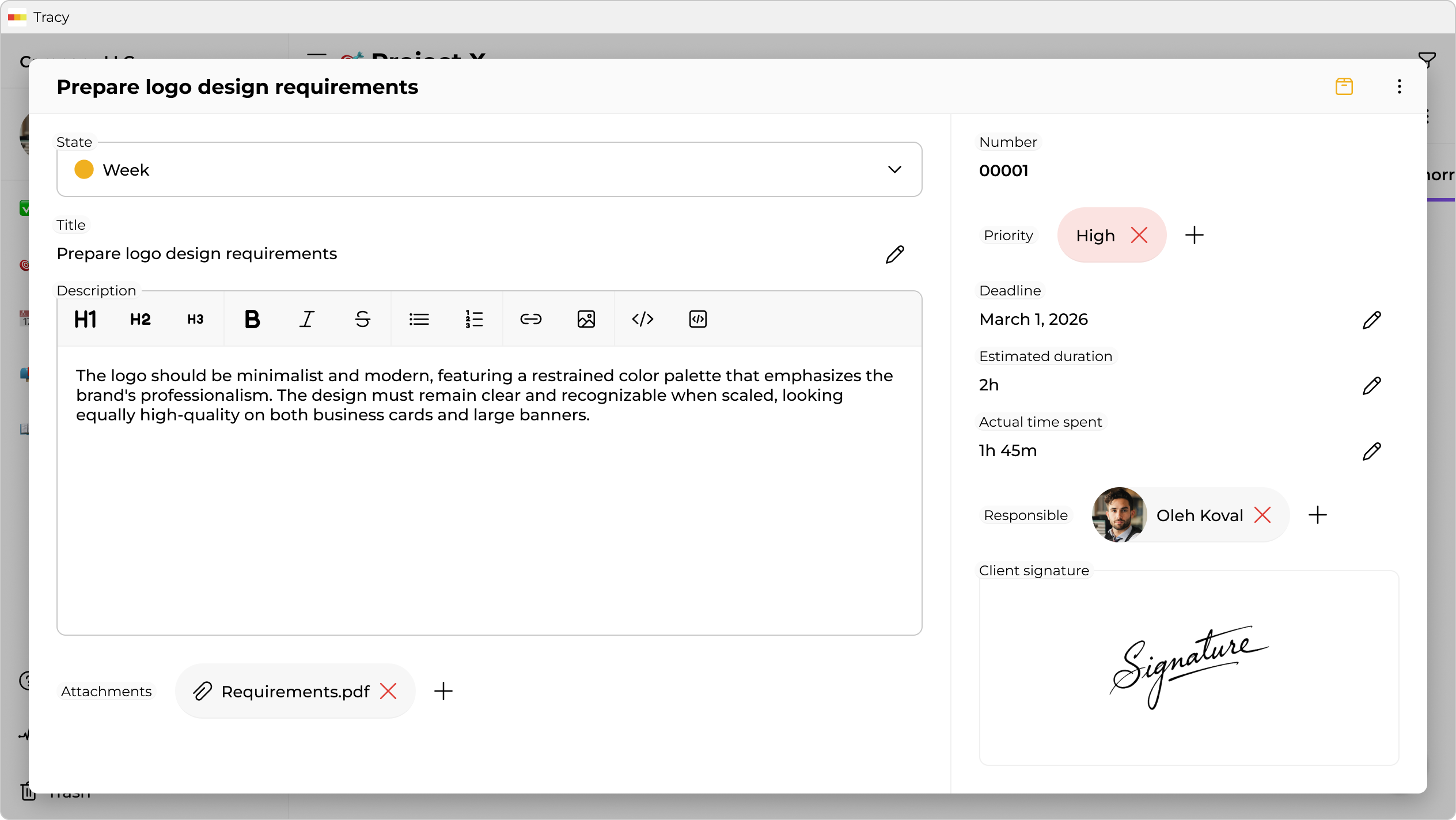
Working with records is done on the home screen of the app.
Adding a Record
To add a record, first select the appropriate dataset in the sidebar catalog, then click the blue “+” button at the bottom right of the screen.
In the window that opens, specify the value of at least one of the properties available to you and click “Save”.
Viewing and Editing a Record
To open a record, click on the corresponding row in the table, card on the board, and so on. In the window that opens, you can make changes—they are saved automatically without confirmation.
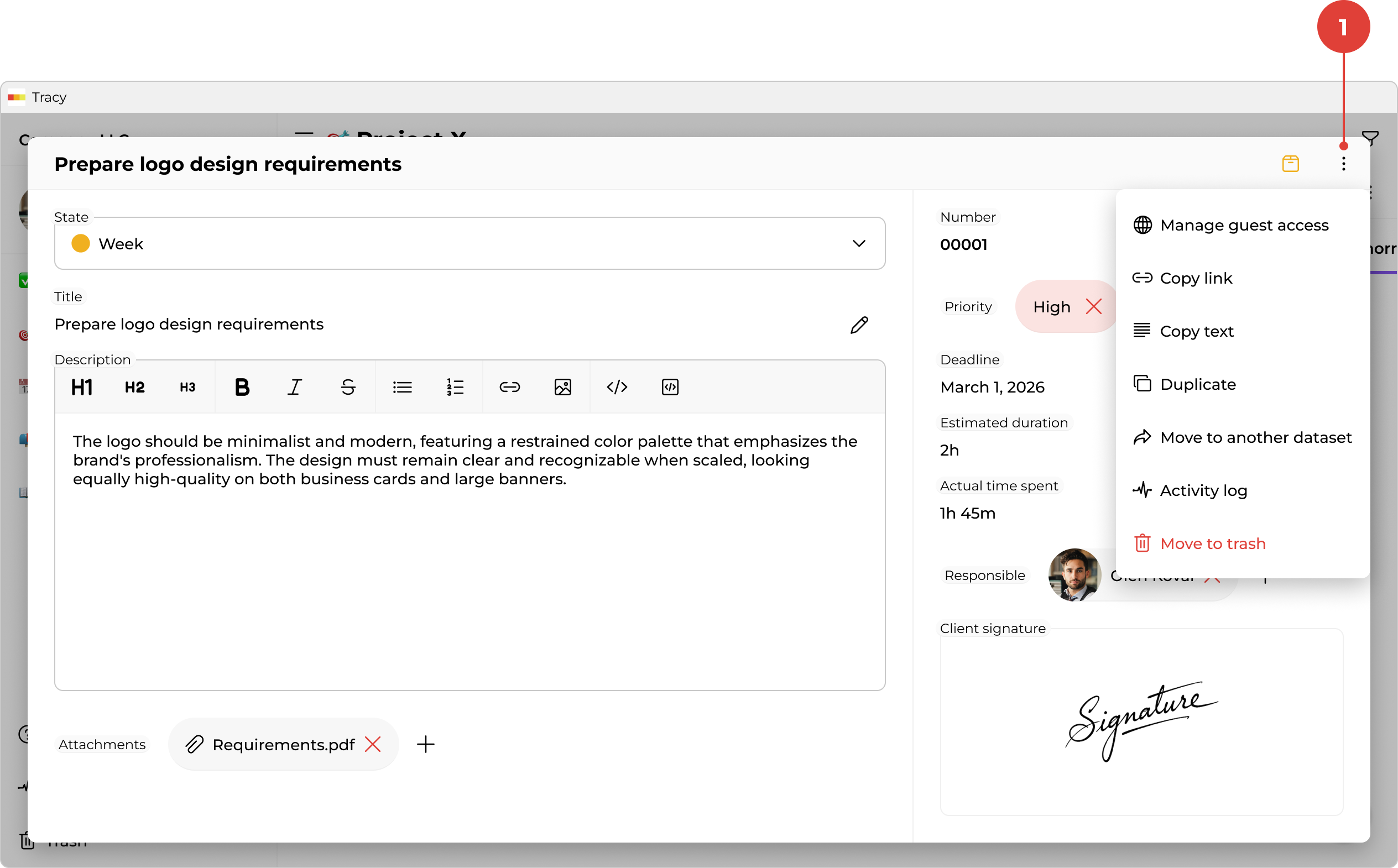
Most actions on a record are available through its context menu. To open it, click the three dots ① at the top of the open record.
Changing a Record’s State
To move a record to a different state, open it and select the desired state from the dropdown at the top. You can also change the state directly on the Kanban board by dragging the card to the appropriate column.
Guest Access to a Record
You can grant an external person access to a specific record or record creation form without requiring them to register in Tracy—via a unique link. For more details, see the “Guest access” section.
Copying a Record
To copy the record’s contents as text or copy a link to it (to quickly share it with a colleague), select the appropriate option from its context menu.
Duplicating a Record
To create a copy of a record, select “Duplicate” from its context menu. A new record will be created with the same property values. Images, files, and signatures are not copied.
Moving a Record to Another Dataset
To move a record to another dataset, select “Move to another dataset” from its context menu. For more details, see the “Moving between datasets” section.
Record Activity Log
Each record has its own activity log showing the full history of changes: who did what and when. To view it, select “Activity log” from its context menu. For more details, see the “Activity log” section.
Archiving a Record
Records that are no longer active but may be needed later (for example, for statistics) can be archived. Archived records are hidden by default but remain accessible via a filter. To archive or unarchive a record, click the corresponding button near its title, to the left of the three-dot context menu. For more details, see the “Archive” section.
Moving a Record to Trash
Records that are no longer needed can be moved to the trash. They can only be permanently deleted by a user with extended or full access to system settings. To move a record to the trash, select “Move to trash” from its context menu. For more details, see the “Trash” section.