Timesheet: How to Calculate the Real Cost of Services and Uncover Hidden Losses
If you sell services or create an intellectual product, time is your commodity. Not tracking it is like a supermarket skipping inventory checks in its warehouse. You know goods are disappearing, but you don’t know whether they were sold, stolen, or spoiled.
Today, we’ll talk about the timesheet not as a bureaucratic relic for accounting, but as a powerful management accounting tool that directly impacts net profit.
Why You Lose Money Without Time Tracking: The Math of Cost
Imagine this situation: you have two clients. Both pay $2,000 per month for services (a retainer). At first glance, they seem equally valuable to the company.
But once you implement time tracking, you notice the following:
- Client A: the team spends 10 hours per month. Everything runs smoothly.
- Client B: requires endless approvals, revisions, and calls. The team spends 60 hours.
If one hour of your specialist’s work (including salary, taxes, office rent, and equipment depreciation) costs the company $40, the math looks like this:
- Cost of Client A: $400. Profit: $1,600.
- Cost of Client B: $2,400. Loss: −$400.
Without time tracking, Client B looks like a good customer who brings in money. With time tracking, you see that you’re actually paying them for the privilege of working together.
Statistics: According to studies by Accelo, Voux, and Insurance Business, companies that don’t keep detailed time records lose over 20% of potential revenue due to so-called time leakage—work that is done but never billed to the client.
Finding “Black Holes”: Process Auditing
As an owner, it’s important to know not only for whom the work is being done, but also what kind of work it is. A timesheet allows you to categorize tasks and answer the question: “Why are we working so much but moving so slowly?”
1. Analyzing Non-Billable Hours
How much time do your expensive specialists spend on tasks that don’t directly generate revenue?
- Internal meetings that could be replaced with an email.
- Manual report preparation.
- Software setup and configuration.
If you see that your lead engineer, earning $30/hour, spends 20% of their time formatting documentation, you’ll realize it’s cheaper to hire an assistant for $5/hour or automate this routine.
2. Assessing the Profitability of Fixed-Price Projects
When you sell a fixed-price project, you’re “placing a bet”. You hope to complete the work faster than what was estimated. Time tracking shows reality. By comparing planned vs. actual time on completed projects, you may uncover a systemic issue—for example, the “Design” phase always takes twice as long as what you sell. That’s a signal: either raise prices or change something in the design department.
Even more importantly, having an objective picture allows you to react to overruns during the project, before they become critical.
Objective Performance Evaluation: The End of the “Favorites” Era
In many companies, performance evaluation (KPIs) is based on a manager’s subjective feelings: “Oleh seems to try hard, stays late, while Andrii leaves exactly at 6:00 PM”.
A timesheet breaks these stereotypes and provides solid data:
- Speed vs. quality. You can compare how much time different employees spend on similar routine tasks. If Andrii completes a task in 2 hours and Oleh takes 6, that’s a reason to investigate. Maybe Oleh isn’t slacking off but doing deeper, higher-quality work? Or maybe he lacks certain skills? Or is overloaded with other “invisible” tasks?
- Discipline and engagement. You can see work patterns. Some people work in bursts right before deadlines; others maintain a steady pace.
- Burnout prevention. Paradoxically, a timesheet helps managers protect valuable employees. If you see someone consistently logging 50+ hours per week, they’ll burn out and quit soon. Hiring and training a replacement will cost you 3 to 6 monthly salaries. It’s cheaper to notice overload in time and redistribute tasks.
Legal Protection for Your Business
Don’t forget the legal aspect. Transparency is your armor. If a labor dispute arises, an employee claims unpaid overtime, or a client demands a report on “what you did all month”, a properly maintained timesheet is your strongest evidence.
A telling case: the lawsuit against the Canadian bank CIBC became textbook material. Because the company ignored actual employee overtime (considering it “voluntary”), the court ordered the bank to pay $153 million in compensation. A clear tracking system and overtime policy could have saved that amount.
How It Works in Tracy: Practice Without Bureaucracy
The biggest challenge in implementing time tracking is staff resistance. No one wants to fill out Excel spreadsheets at the end of the week, trying to remember what happened on Monday. That’s why in Tracy we made the process as “painless” and integrated into daily work as possible.
1. Logging Time “In the Moment”
In Tracy, time tracking isn’t a separate, complex procedure. An employee works on a task and logs the time directly inside it. It’s simple: open the task → do the work → enter “2 hours” in the time field → close the task. It takes 5 seconds but creates a data foundation for powerful analytics.
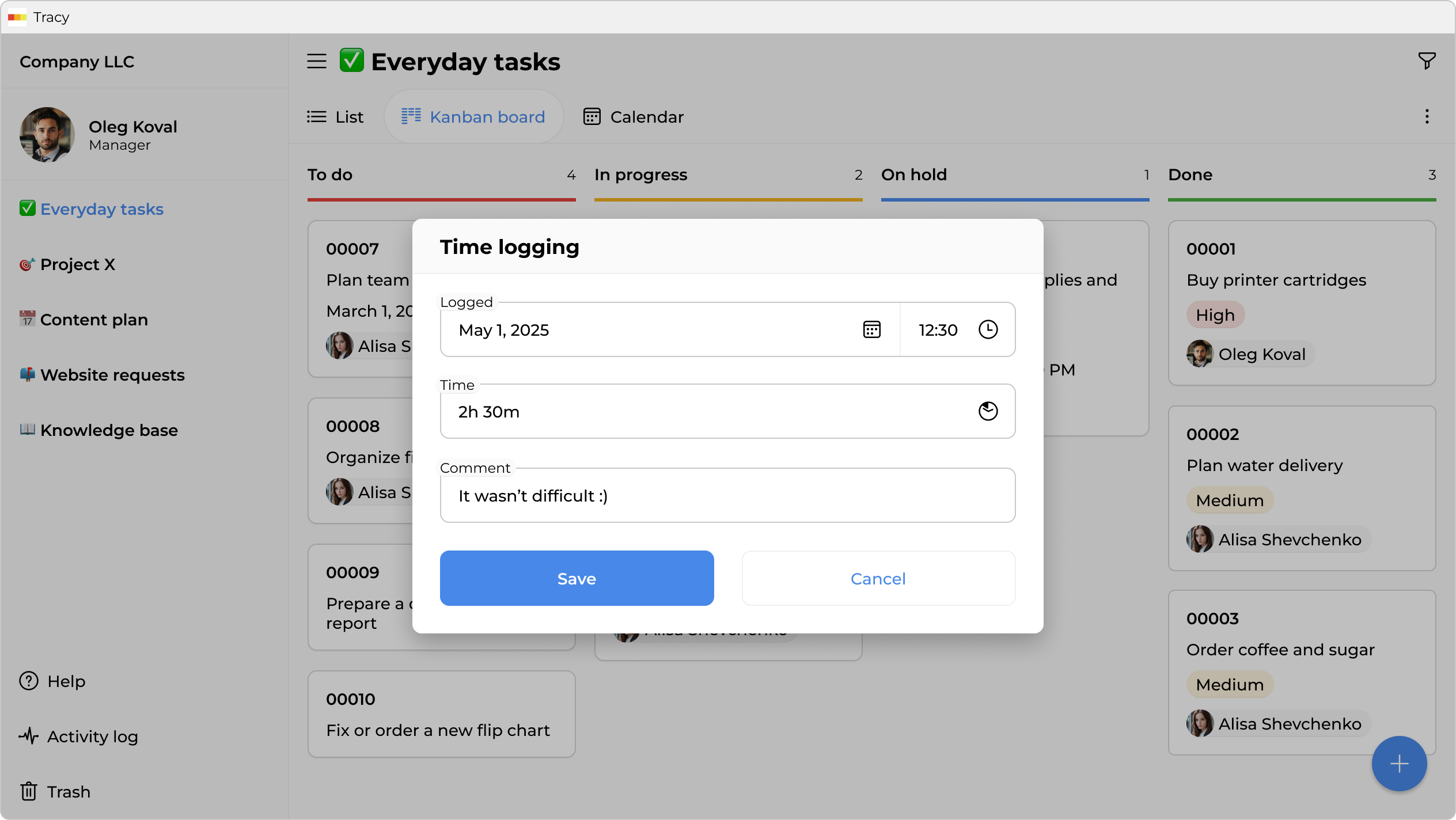
It’s important to log time daily, not at the end of the week or, worse, the month. That way, the numbers are as honest as possible, and the process meets less resistance. Initially, you can assign a person responsible for daily timesheet checks to keep the rhythm.
2. Team Timesheet: A Top-Down View
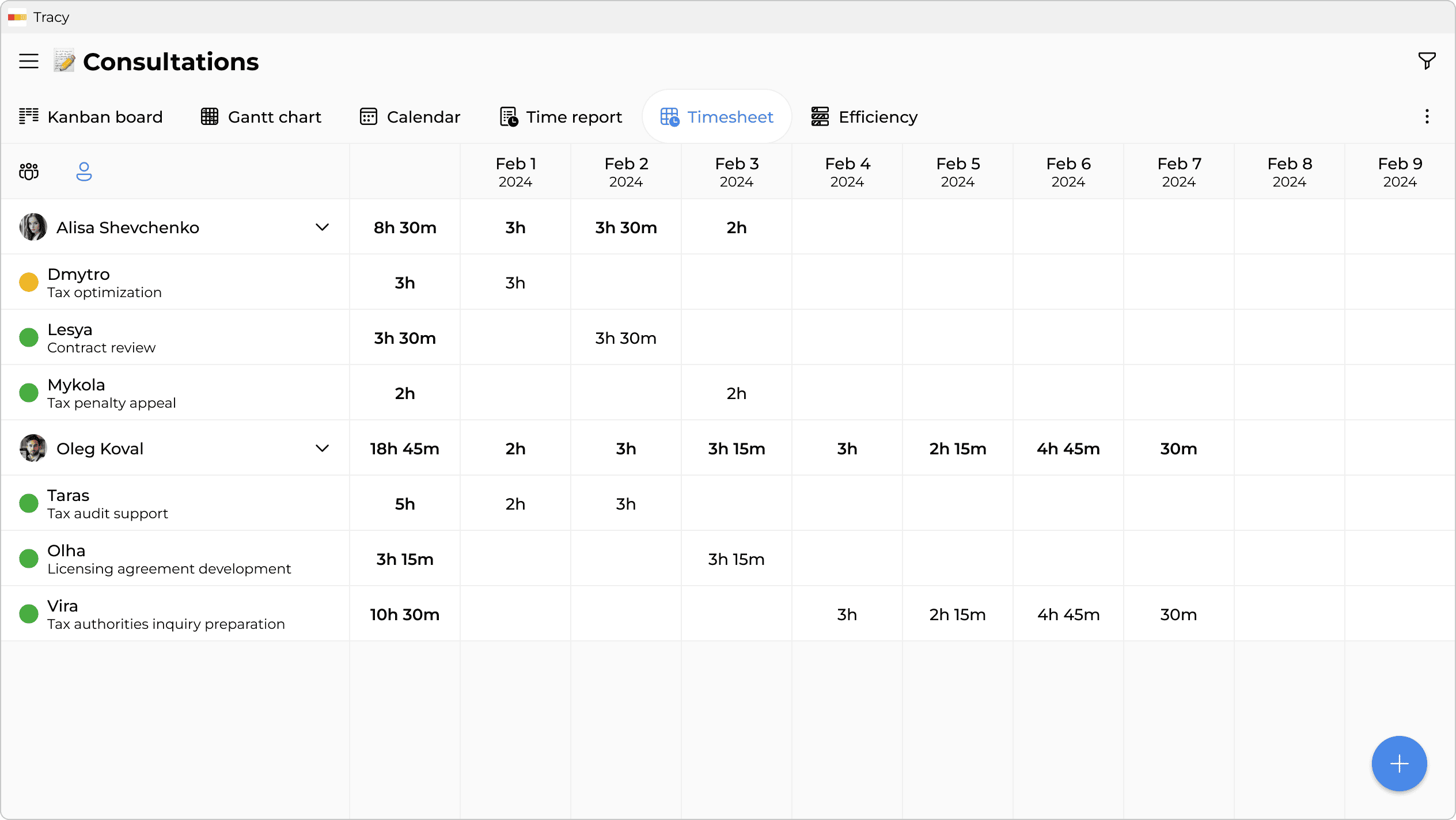
Managers have access to a consolidated report. You can generate a timesheet for any period (week, month, quarter) broken down by:
- Executors: who worked how much and on what.
- Projects/clients: the real labor intensity of each project.
This allows you to instantly spot workload imbalances: who’s overloaded and who’s underutilized.
3. Financial Analytics of Tasks
You can filter tasks that took the most time during a selected period. This is your “food for thought”. Look at the top 5 most time-consuming tasks of the month and ask yourself:
- Did these tasks generate revenue for the company?
- Could they have been automated?
- Does it make sense to take on similar projects at this price in the future?
Tracy turns time from an abstract concept into a concrete metric. This helps you move away from assumptions toward hard facts. And that’s exactly the approach that transforms chaotic craftsmanship into a predictable, systematic business.
 Dmytro Sikorskyi